

Understanding Binary Counters and Their Uses
Explore how binary counters work, their types, key applications, and design tips 🛠️. Perfect guide for engineers and students in Pakistan seeking practical insights.
Edited By
Sophie Wilson
Extended binary trees are an important variation of the standard binary tree, widely studied in computer science and data structures. Unlike typical binary trees, which only include internal nodes containing data, extended binary trees also include external nodes or null nodes. These external nodes represent missing children, making the tree’s structure explicit and easier to analyse.
In practical terms, imagine a binary tree used to organise data for quick searching or sorting. A standard binary tree leaves out null children, which can sometimes complicate the understanding of how many nodes actually exist or how algorithms behave at leaf level. Extended binary trees solve this by explicitly adding these external nodes as placeholders.
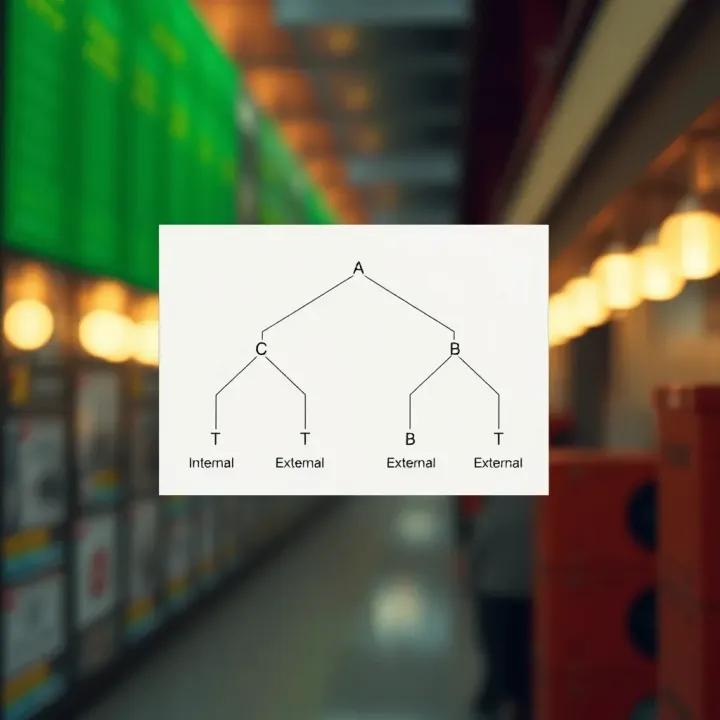
Every internal node has exactly two children, which may be internal or external nodes.
External nodes represent the absence of a child — effectively marking the 'end' of a branch.
The total number of external nodes is always one more than the internal nodes in a non-empty extended binary tree.
These properties make extended binary trees helpful when implementing traversal algorithms, balancing trees, and managing storage in ways that need precise control over tree structure.
Extended binary trees clarify the shape and boundaries of a binary tree by making absent children explicit, assisting in performance analysis and algorithm design.
From an application perspective, these trees find use in data compression, expression parsing, and constructing binary heaps. For traders and financial analysts handling large datasets, understanding these structures can improve the performance of search and sort operations, which directly impacts speed and efficiency.
Expression trees in calculators and compilers, where every operator and operand is organized clearly with null children to mark leaf nodes.
Binary search trees with explicit end markers to ease insertion and deletion operations.
Data indexing structures for rapid query responses needed in broker software platforms.
Having this grasp over extended binary trees helps educators and professionals grasp more complex tree-based structures more confidently, thus improving teaching and application in real-world computing tasks.
In upcoming sections, we’ll further explore their structural differences from regular binary trees, traversing techniques, and practical examples relevant for Pakistani tech and finance experts.
Understanding extended binary trees starts with recognising how they differ from traditional binary trees. Unlike a standard binary tree, where absent children are simply considered null, an extended binary tree explicitly includes these absent nodes as external nodes. This explicit structure helps in formalising algorithms and improving the clarity of tree operations, especially in recursive processes.
Internal nodes are the usual nodes of a binary tree that contain data and have pointers to children. In extended binary trees, every null or missing child pointer is replaced by an external node, which is a special type of node without data, primarily representing the absence of a child. This distinction between internal and external nodes offers a complete view of the tree’s structure, making it easier to reason about the tree’s properties.
For example, if a node in a normal binary tree has only one child, the other child pointer points to null. In an extended version, that null pointer is taken up by an external node. This keeps the tree strictly binary, with each node having exactly two children—either an internal or external node.
The main goal of adding external nodes is to simplify certain algorithms, such as tree traversal or insertion. Since each internal node has exactly two children (internal or external), recursive methods no longer need to check for null pointers explicitly. This uniformity in structure helps in designing consistent operations like traversal and height calculation.
Additionally, external nodes help in accurate counting of nodes during analysis, which proves valuable for complexity considerations or proofs related to tree algorithms. In practical terms, this approach avoids ambiguity when dealing with empty subtrees, especially in decision trees or expression trees used in various applications.
A simple binary tree with three nodes might have nodes A, B, and C, where A is the root, B is its left child, and C is its right child. In a normal binary tree, if B lacks children, those spots are simply null. But in an extended tree, those nulls get replaced by external nodes drawn as small circles or squares.
Visually, this means an extended tree appears fuller and more uniform, showing both the internal nodes and all the missing child spots. This fullness aids programmers and analysts in understanding where the tree stops branching, which is less obvious in a traditional tree diagram.
Including external nodes makes diagrams more explicit, reducing confusion when interpreting empty subtrees. For traders or financial analysts working on decision trees for risk assessment, the clarity to see exactly where branches end prevents misinterpretation.
Moreover, in educational settings or technical presentations, these explicit external nodes provide a solid foundation to explain recursive operations. It becomes clearer when a recursive call terminates or how subtrees contribute to overall tree shape, improving comprehension and reducing ambiguity in problem-solving contexts.
By visibly marking external nodes, you lay bare the tree's full structure, making analysis and algorithms more straightforward and transparent.
This transparency is especially useful in programming, where extended binary trees show the explicit tree size and structure, crucial for implementing balanced trees or error detection during tree modifications.

Understanding the core properties of extended binary trees is essential for anyone working with data structures, especially when dealing with recursive algorithms or complex tree traversals. The clear relationship between internal and external nodes helps simplify operations while providing a solid framework to analyse tree behaviour.
In an extended binary tree, internal nodes are the actual elements containing data, while external nodes represent the null children explicitly. These external nodes help maintain uniformity in tree representation and are crucial in recursive algorithms where encountering a ‘null’ child is a common base case. Practically, this means that every internal node has exactly two children—either internal or external.
The relationship between internal and external nodes is straightforward yet powerful: for a binary tree with n internal nodes, the number of external nodes will always be n + 1. This property leads to a predictable node count and helps in optimising memory allocations when implementing data structures such as expression trees or decision trees.
Extending this further, the total number of nodes in an extended binary tree becomes 2n + 1, where n is the count of internal nodes. This explicit counting is especially helpful for algorithms that rely on complete tree traversal, as the external nodes provide clear stopping points for recursion. For example, when building an expression tree to parse mathematical formulas, the external nodes denote where the operands end, supporting efficient evaluation.
External nodes influence how the height of an extended binary tree is computed. Since these nodes represent null children, they effectively mark the boundary of the tree, making it easier to measure height consistently. Including external nodes prevents ambiguity in height calculations that traditional binary trees might face when children are missing or null. This is particularly useful in balanced tree implementations where accurate height measurement impacts performance.
Maintaining tree balance gains more clarity with the presence of external nodes. Balanced trees, like AVL or Red-Black trees, depend on height differences between subtrees. Explicit external nodes ensure that every path from root to leaf has a well-defined length, simplifying balance checks. For instance, when inserting or deleting nodes in such balanced trees, recognising external nodes helps maintain the desired height constraints, improving efficiency in searching or sorting tasks.
Explicitly counting external nodes clarifies many aspects of tree operations, from memory management to algorithm design, making extended binary trees a practical choice for various computer science applications.
In summary, these properties not only provide a solid theoretical foundation but also translate into practical benefits like simplified recursive algorithms, precise height measurement, and easier balance enforcement, all essential for developers, educators, and analysts working with complex tree structures.
Understanding the differences between extended binary trees and traditional binary trees helps clarify why extended trees hold a special place in computer science, especially in algorithms and data structure design. This comparison is crucial because it underlines how node representation and handling of null children impact tree traversal, algorithm complexity, and even how the tree balances itself.
Standard binary trees handle null children differently: In a traditional binary tree, nodes have pointers or references for their children, which can either point to another node or be null if the child does not exist. These null pointers are implicit; that is, they are simply empty references without an actual node occupying that spot. For example, if a node has a left child but no right child, the right pointer is null, representing an absent child. This approach keeps the structure lean but requires algorithms to constantly check for null references during traversal or manipulation.
Extended trees use explicit external nodes: Unlike traditional trees, extended binary trees represent each null child with a distinct external node. These external nodes act as placeholders, often containing no data or a special marker, explicitly showing where children do not exist. For instance, in expression trees, these external nodes make it easier to represent leaves and facilitate uniform recursive definitions. This explicit representation means every internal node has exactly two children—either internal or external—which simplifies some calculations and recursive procedures.
Simplifying recursive algorithms: Extended binary trees make recursive algorithms cleaner by standardising node handling. Since external nodes are real nodes and not null pointers, recursive functions don’t need extra null checks. For example, when calculating tree height or performing traversals, the algorithm treats external nodes just like internal nodes, returning base values directly. This uniformity decreases the chance of bugs due to null reference checks and often improves code readability for programmers.
Supporting detailed tree traversal: Explicit external nodes provide a more detailed structure during traversals. In level order or preorder traversals, external nodes appear as distinct points, making error detection and debugging clearer. For example, while exploring decision trees, explicit external nodes help signify terminal decisions or leaves with no further branches, offering a transparent traversal path. This detail also assists in certain tree analysis techniques where the presence or position of external nodes carries semantic meaning.
Extended binary trees, by representing null children explicitly, offer practical advantages in algorithm design and traversal, making them especially useful when precision and clarity are essential.
In summary, the choice between traditional and extended binary trees depends on the application’s needs. Extended trees might add overhead in terms of node count but pay back by simplifying traversal and algorithms. This balance is crucial for data structure designers and software engineers in fields like compiler construction, artificial intelligence, or database indexing to grasp fully.
Traversal methods are central to understanding and working with extended binary trees. They enable us to systematically visit each node in the tree, capturing the tree’s structure and content effectively. For traders, investors, and analysts who deal with decision trees or algorithmic models, mastering these traversals helps in clearer analysis and debugging. Unlike standard binary trees, extended binary trees explicitly include external nodes, which changes how traversal algorithms process the tree.
Handling external nodes during traversal involves recognising that external nodes represent null or absent children but must be accounted for explicitly. In traditional trees, null children are simply ignored, but in extended binary trees, these external nodes are part of the structure. Traversal algorithms must therefore include checks for these nodes, often treating them as leaf nodes with no further children. This explicit inclusion simplifies recursive algorithms by removing conditional checks for null pointers.
For example, during an inorder traversal, when the algorithm encounters an external node, it simply records that node before backtracking. This makes tree operations like expression evaluation or decision analysis more robust, as all possible branches, including empty ones, are clearly represented.
Example walkthrough: Consider a simple extended binary tree representing a mathematical expression such as (3 + 5). Internal nodes hold operators, while external nodes mark missing branches. Starting from the root with preorder traversal, you visit the operator node first, then recursively traverse the left child, followed by the right child. External nodes are visited explicitly and can be marked as null or placeholders. This process keeps the tree structure intact and the traversal consistent.
Application in breadth-first searches is particularly useful in scenarios requiring a layer-by-layer examination of the tree. Level order traversal visits nodes one level at a time from top to bottom, which can be crucial when analysing decision trees in financial models or evaluating options at each depth before proceeding further. This method often uses a queue to manage nodes waiting to be visited.
With extended binary trees, representation of external nodes in queue-based traversal ensures that every position in the tree, including absent children, is accounted for. When an external node is dequeued, it signifies a null branch, which may be important in error checking or in algorithms that rely on complete tree representation. This explicit handling prevents misinterpretation of the tree’s shape and helps identify unbalanced or incomplete data structures.
Explicitly including external nodes during traversal simplifies tree-related computations and ensures accurate representation, which is vital for coding algorithms reliably in real-world applications.
In summary, traversal methods tailored for extended binary trees provide clarity and consistency when dealing with complex tree-based models. Their thorough processing of both internal and external nodes supports better algorithm design and reliable data analysis, which is valuable for professionals working with structured data.
Extended binary trees find practical use across several areas in computer science. Their unique representation, including external nodes for null children, makes them valuable in data structure implementation and improving algorithmic clarity. This section highlights key applications, showing how the extended format supports specialised use cases and simplifies certain operations.
Expression trees use extended binary trees to represent arithmetic expressions clearly. Each internal node typically stands for an operator (+, -, ×, ÷), while leaves hold operands like variables or constants. External nodes explicitly mark absent children, which makes parsing and evaluation more straightforward, especially when expressions are incomplete or malformed. For example, when compiling or interpreting code, expression trees help convert infix expressions into postfix or prefix notation systematically.
Decision trees benefit from extended binary trees by explicitly marking paths for both positive and negative decisions, even when one branch is missing. This clarity helps in machine learning models and rule-based systems where decisions depend on multiple conditions. The external nodes here denote leaf decisions or unused paths, making traversals and pruning operations easier for optimising decisions or detecting missing logic.
Using extended binary trees often simplifies recursive algorithms. Since every node, including external ones, is handled uniformly, recursion conditions become easier to set without special cases for null children. This uniformity reduces coding errors and aids readability. For example, computing tree height or performing traversal operations can consistently process every node without explicit null checks, making algorithm design cleaner and less error-prone.
Extended binary trees also support error detection and handling in tree operations. With clearly defined external nodes, algorithms can quickly identify missing children or incomplete sections of a tree. This is particularly helpful during debugging or validating data structures where structural integrity matters. For instance, applications like syntax checking in compilers or consistency verification in decision trees depend on detecting these explicit external nodes to flag abnormalities.
Explicit external nodes in extended binary trees act as safety nets, catching missing or invalid connections early and ensuring more robust tree-based computations and data handling.
In summary, the applications and algorithmic benefits of extended binary trees show why they are more than just theoretical constructs. Their practical value shines in data representation clarity and simplifying recursive processes, which is especially useful for educators, analysts, and developers working with complex hierarchical data.
Understanding how to build an extended binary tree provides valuable insights into the structure's practical use and its distinction from a regular binary tree. This example-focused section emphasises concrete steps that demonstrate the role of internal and external nodes, helping readers grasp the construction process clearly. By walking through a real example, learners can more easily apply these concepts in algorithm design or data structure implementation.
Internal nodes form the backbone of any extended binary tree. These are the actual data-holding elements that represent meaningful values or decisions, such as nodes in an expression tree or a decision-making flowchart. To add internal nodes, you start with a root node and then add child nodes according to the intended hierarchical relationship. For instance, when constructing an expression tree for arithmetic operations, internal nodes would typically represent operators (like +, -, ×, ÷), while leaves might hold operands.
Careful placement is essential to maintain the tree’s balance and usefulness. For example, if you add an internal node without corresponding child nodes or placeholders, you break the extended tree structure. That’s why internal nodes should always be inserted anticipating their external children, which leads us neatly to the next step.
External nodes are essentially placeholders representing the absent children where a standard binary tree would have nulls. In the extended binary tree, each null link is replaced by an external node, making it explicit and counting towards the total structure. This explicit representation simplifies recursive operations, error detection, and traversal.
For example, after inserting an internal node that has only one child, you insert an external node in place of the missing child to maintain the complete extended binary tree property. This step avoids ambiguity about whether a child node exists or not, which is particularly useful in algorithms that process trees dynamically, such as parsing or memory management.
A common misunderstanding is treating external nodes as regular data-bearing nodes, which they are not. External nodes only represent the absence of a real child and should not carry data or be confused with internal nodes. Confusing these can cause logical errors in traversal and impact algorithm correctness.
Remember, external nodes are structural markers, not functional elements. Recognising their role avoids overcomplicating the tree and helps maintain clarity during implementation.
Another frequent error is miscounting nodes, especially when calculating tree size or depth. Since external nodes are explicitly represented, the total node count in an extended binary tree is always larger than a standard binary tree with the same internal nodes. Forgetting to include external nodes leads to wrong assumptions about tree properties.
Always count both internal and external nodes when analysing or writing algorithms for extended binary trees to ensure accurate results. For example, a tree with 5 internal nodes will have 6 external nodes, as per the property of extended binary trees.
Precise understanding of node roles and careful construction steps prevent common pitfalls in working with extended binary trees, leading to more reliable data structures and algorithms.
By following these guidelines, anyone working with extended binary trees—from educators to analysts—can build and utilise these structures with confidence and accuracy.
Explore how binary counters work, their types, key applications, and design tips 🛠️. Perfect guide for engineers and students in Pakistan seeking practical insights.

Explore how binary counters work, their design types, and real-world uses in digital circuits 🖥️. Get a clear view of counting sequences and applications!

Learn how binary converters work 🔢 and why they matter in computing and daily tech 📱. Clear, practical guide for all readers, including Pakistan 🇵🇰.

Explore the world of binary compounds ⚛️ from their composition and bonding to properties and real-life uses in chemistry and industry, tailored for Pakistan.
Based on 12 reviews