

Decimal to Binary Conversion Explained
🔢 Learn to convert decimal numbers into binary easily! Step-by-step explanations, examples, and practical tips to understand this essential number system concept clearly.
Edited By
James Ashford
Every day, devices in Pakistan’s tech sector rely on simple yet powerful number systems. Decimal, or base-10, is the number system we use naturally — it runs from 0 to 9. On the other hand, binary, or base-2, uses only 0 and 1. This difference matters because computers handle data in binary, not decimal.
A decimal to binary calculator helps convert numbers from the system humans use to the one machines understand. For example, transforming the decimal number 13 into binary yields 1101. This conversion is crucial for software developers and engineers who write code, perform calculations, or work on embedded systems.
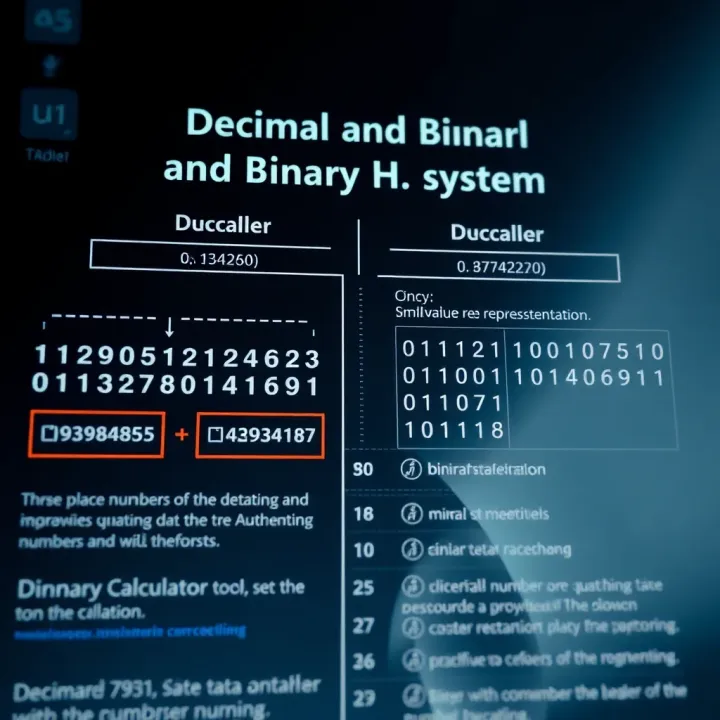
Understanding how decimal to binary conversion works offers practical benefits, especially in Pakistan’s growing IT and electronics industries.
Pakistan’s tech ecosystem includes software firms, electronics assembly plants, and educational institutions where binary knowledge helps in:
Programming: Most programming languages depend on binary at the machine level to process instructions.
Data Storage: Memory chips and storage devices record data using binary patterns.
Network Communication: IP addressing and routing rely on binary math.
For traders and financial analysts, binary concepts come into play in algorithmic trading or digital transaction processing, where calculations must be precise and machine-friendly.
While decimal to binary calculators simplify the process, knowing manual methods improves intuition:
Divide the decimal number by 2.
Record the remainder (0 or 1).
Continue dividing the quotient by 2 until it’s zero.
Read all remainders in reverse order to get the binary number.
For instance, to convert 25:
25 ÷ 2 = 12 remainder 1
12 ÷ 2 = 6 remainder 0
6 ÷ 2 = 3 remainder 0
3 ÷ 2 = 1 remainder 1
1 ÷ 2 = 0 remainder 1
Reading remainders backwards: 11001.
Though manual conversion works, decimal to binary calculators save time and prevent errors, especially for larger numbers or calculations undertaken by professionals in finance or tech sectors.
This foundation sets the stage to explore the inner workings of decimal to binary calculators and their role in Pakistan’s digital landscape.
Understanding the decimal and binary number systems is fundamental for anyone dealing with digital technology, particularly in finance, programming, or data analysis. These systems form the backbone of how information is stored, processed, and exchanged in modern computing environments, including those widely used in Pakistan.
The decimal number system, or base 10, is the numeric model most people use daily. It consists of ten digits: 0 through 9. This system evolved naturally due to humans having ten fingers, making it intuitive for counting, arithmetic, and pricing goods or services—situations very common in Pakistani bazaars or even in stock trading.
This system underpins everyday activities such as managing budgets, understanding bank statements, or analysing market prices on the Pakistan Stock Exchange (PSX). For instance, when you see a share priced at Rs 150, it is expressed in decimal form.
Decimal numbers rely on place value: the position of a digit determines its worth. From right to left, each place represents powers of ten (ones, tens, hundreds, etc.). For example, the number 2,341 means 2 thousands, 3 hundreds, 4 tens, and 1 one.
This structure helps in breaking down larger figures into understandable chunks, crucial for trader's calculations during buying or selling stocks or goods where precision counts. Place value applies directly to financial calculations and also helps programmers understand how to convert these numbers into other formats such as binary.
Binary works on just two digits: 0 and 1, known as bits. Its base 2 system is essential because digital devices, including Pakistan’s growing IT infrastructure, use it to represent all data. Electronic circuits interpret 0 as 'off' and 1 as 'on', enabling everything from banking software inputs to encrypted messages to function reliably.

Understanding binary helps professionals grasp how computers handle numbers behind the scenes. While investors may not need to use binary daily, knowing its relevance in digital transactions, online trading platforms, or even mobile banking apps offers deeper insight into the technology's workings.
Bits are the smallest unit of data, but eight bits form one byte—enough to represent a single character like a letter or digit. Files, images, and financial reports on computers or mobile apps common in Pakistan are built of bytes.
For instance, a PDF of a balance sheet might be several hundred kilobytes, each byte coded in binary. For traders and analysts, this means the vast amounts of data they handle are ultimately strings of ones and zeros. Understanding this makes it easier to appreciate constraints like data size, processing speed, and even security in digital finance.
Knowing how decimal and binary systems interact is a stepping stone for anyone working with computational tools, financial software, or data communication in Pakistan's tech ecosystem.
In sum, decimal serves daily life and commerce, while binary powers the digital age's technology. Mastery of both concepts aids clear comprehension of calculators that convert decimal numbers to binary and their practical applications.
A decimal to binary calculator plays a key role in quickly translating numbers from decimal (base 10) to binary (base 2), easing work for software developers, engineers, and students especially in Pakistan's growing tech sector. Understanding how it works helps users appreciate the accuracy and speed behind such tools, which are often relied upon for programming, data processing, and networking tasks.
Division and remainder method is the foundation of decimal to binary conversion. The decimal number is divided by 2 repeatedly, while keeping track of the remainder each time. For example, converting the decimal number 13 involves dividing 13 by 2 to get quotient 6 and remainder 1, then 6 by 2 to get 3 and remainder 0, and so on, until the quotient reaches zero. These remainders (0 or 1) represent binary digits. This method is straightforward and mirrors the logical process computers use internally.
Once the divisions are complete, the binary number is not just the remainders in the order they were found. Instead, building the binary number from remainders involves collecting all remainders from last to first. In the 13 example, reading the remainders backward (from the last remainder obtained to the first) forms the binary number 1101. This reversal step is crucial; missing it leads to incorrect conversions. The calculator automates this error-prone step, saving time and reducing mistakes, particularly useful when dealing with large numbers.
Web-based calculators are the most accessible option. They require only an internet connection and a web browser, which makes them popular among students and professionals in Pakistan who may not want to install software. These tools generally provide instant, accurate results and often allow conversions between multiple numeral systems.
Mobile apps popular in Pakistan bring convenience by offering offline usage and user-friendly interfaces on smartphones. Apps like "Binary Converter" or "Number Systems Calculator" on Android and iOS are widely downloaded. They cater to users who need frequent conversions on the go without depending on stable internet access, important in areas facing frequent loadshedding or weak connections.
Offline software tools provide more advanced features for specialised needs and are favoured by tech experts. Desktop applications such as "Windows Calculator" with programmer mode or dedicated software for embedded system design enable batch conversions, large number handling, and programming integration. Offline tools offer better data privacy and can run faster when working with complex calculations.
Whether you use a web tool, mobile app, or offline program, understanding how a decimal to binary calculator works ensures you pick the right tool for your specific need and trust its output fully.
Understanding manual methods to convert decimal numbers to binary is essential, especially for students and professionals dealing with computer science and electronics in Pakistan. While calculators save time, knowing these methods helps deepen comprehension of how binary systems work, improves problem-solving skills, and can be critical during exams or in situations where online tools aren’t available.
The repeated division method involves dividing the decimal number by two and noting down the remainders. Each remainder represents a binary digit starting from the least significant bit (LSB). For example, to convert 13 to binary, divide 13 by 2: quotient is 6, remainder 1; then divide 6 by 2: quotient 3, remainder 0; keep dividing until the quotient is zero. Collecting these remainders is straightforward and shows the direct link between division and binary digits.
Writing the binary digits in the correct order is critical because the first remainder corresponds to the least significant bit. After collecting all remainders, you reverse their order to get the binary number. Using the earlier example, the remainders were 1, 0, 1, 1; reversing yields 1101, which is 13 in binary. This step prevents mistakes in representation and highlights the importance of digit placement in binary numbers.
This method begins by identifying the highest power of two less than or equal to the decimal number. For instance, for 37, the highest power of two is 32 (2^5). Recognising this helps in quickly breaking down the number into sums of powers of two, which are the building blocks of binary numbers.
Next, subtract this power of two from the decimal number and track the remaining value. Keep subtracting the next lower powers of two until the remainder reaches zero, marking a '1' for powers used and '0' for powers skipped. Using 37 again, subtract 32 (remainder 5), then 4 (remainder 1), then 1 (remainder 0). This results in binary digits: 1 (32), 0 (16), 0 (8), 1 (4), 0 (2), 1 (1), giving 100101 in binary. This approach reinforces how binary numbers reflect powers of two, which is especially useful in programming and hardware contexts.
Manual conversion methods offer practical insight into the construction of binary numbers and underpin understanding crucial for fields such as programming, networking, and digital electronics, all significant in Pakistan’s growing tech industry.
Decimal to binary conversion plays a vital role in Pakistan's growing tech and educational environment. It is more than just a number system exercise; it underpins essential processes in programming, digital communications, and academic learning. Understanding how and where binary numbers are used helps bridge theoretical knowledge with practical applications in everyday technology.
Software development basics: Binary forms the backbone of computer code, and programmers constantly deal with it, even if indirectly. In Pakistan’s IT sector, software development often involves dealing with low-level data operations where decimal inputs from users convert into binary for processing. For instance, developing mobile apps for Pakistan’s digital payment platforms like JazzCash or Easypaisa requires handling data in binary for encryption, validation, and system compatibility.
Embedded systems and hardware interfacing: Many devices used in Pakistani households and industries — from smart meters in energy distribution to home appliances — depend on embedded systems. These systems work with microcontrollers that only understand binary. Knowing decimal to binary conversion helps engineers ensure proper hardware interfacing and debugging. For example, when a technician programs a microcontroller to read sensor values, those decimal readings get translated to binary signals to trigger alerts during loadshedding or control device behaviour.
Binary data transmission: At the core of internet and mobile communications is data transmitted as binary signals. In Pakistan, where digital connectivity expands rapidly, binary data transmission ensures efficient and secure communication. When you send a message over Careem or browse a website, the decimal data representing your input is converted into binary sequences that routers and switches process. This conversion is critical to maintain data integrity across networks.
IP addressing and subnetting: The binary system is also fundamental in managing IP addresses and subnetting in networking. Network administrators in Pakistan use binary conversion to organise local networks, assigning IP addresses in a way that optimises bandwidth and security. For example, when setting up a corporate network in Karachi, IT staff convert decimal IP addresses to binary to calculate subnet masks accurately, which prevents data congestion and unauthorised access.
Importance in matric and intermediate computer science: Binary and its conversion from decimal form a major part of the computer science curriculum at the matric and intermediate levels. Pakistani students learning these concepts gain foundational skills required for IT and engineering fields. Teachers often use decimal to binary calculators to help students check their manual conversions and understand digital logic clearly.
Preparation for engineering and IT exams: For students preparing for engineering entrances like ECAT or computer science modules in universities such as NUST and FAST, mastering decimal to binary conversion is crucial. Exams frequently include questions on binary arithmetic and logic circuits. Practical knowledge of this conversion equips candidates to solve problems faster and with higher accuracy, especially in competitive settings.
Mastery of decimal to binary conversion bridges theory and practice, strengthening Pakistan's technology ecosystem and building student competence in computer science and engineering.
Overall, decimal to binary conversion is not an isolated concept but a practical skill with real-world applications in Pakistan’s IT development, digital communications, and education.
Online decimal to binary calculators offer a quick and reliable way to convert numbers without manual errors. In Pakistan’s fast-paced tech scene, they save time and simplify complex calculations, especially for traders, financial analysts, and educators who work with digital data regularly. Selecting the right calculator depends on practical features like accuracy, user interface, and available support for additional functions.
Accuracy is fundamental for any calculator because even a small mistake can cause significant errors in programming or data analysis. The best tools ensure precise conversion by strictly following binary conversion rules, like the repeated division method. Users should also find the interface straightforward — clear input boxes, visible results, and minimal distractions. For example, a trader working with financial algorithms can’t afford to waste time correcting miscalculations caused by a faulty or confusing tool.
Tools with simple designs work well on mobile devices too, which is important in Pakistan where many users rely on smartphones for everyday tasks. Being able to get results quickly on phones or tablets helps maintain productivity even during loadshedding or when travelling.
Some calculators go beyond decimal-to-binary conversion. They also offer conversions between binary, octal, and hexadecimal systems. These extra features are handy for developers and students preparing for engineering exams who often encounter multiple number systems.
Moreover, calculators that provide brief explanations or step-by-step conversion details add real educational value. This helps users understand the underlying process, not just get answers. For instance, a computer science student in Karachi preparing for the HEC engineering entry test benefits from seeing how decimals translate into binary stepwise, making exam preparation more effective.
Pakistani tech portals often offer customised calculators tailored to local users’ needs. These portals might include Urdu language support or integrate guides relevant for Pakistani students and professionals. Their calculators usually align well with curricula and frequently used tools in Pakistan’s IT education.
Aside from language, local platforms understand Pakistan’s connectivity challenges and design tools that run smoothly on slower internet or lower-end devices. This ensures wider accessibility across urban and rural areas. Examples include tech blogs and education websites popular among matric and intermediate-level students, which combine calculators with contextual learning.
Many international websites provide sophisticated decimal to binary calculators that come with multi-language support, including Urdu and English. These tools often have advanced features like batch conversions or the ability to save calculations, which local tools might lack.
English remains widely used for tech and business in Pakistan, so these international platforms serve well for professionals handling complex data. Their cloud-based nature means updates and improvements are frequent, keeping the tools reliable over time. However, users should verify that these websites load well locally and offer user-friendly navigation to avoid frustration.
Choosing the right decimal to binary calculator hinges on a balance between accuracy, ease of use, and practical features tailored to your specific needs. For Pakistan’s diverse users—from students to financial analysts—accessibility and clear explanations make all the difference.
🔢 Learn to convert decimal numbers into binary easily! Step-by-step explanations, examples, and practical tips to understand this essential number system concept clearly.
Explore balanced binary trees 🌳 – learn key concepts, types, and how maintaining balance boosts data efficiency and programming performance.

Learn binary to decimal conversion in C++ with clear steps, practical code examples, common challenges, and tips for writing efficient, error-free programs 💻🔢.

Learn how to convert decimal numbers to binary with clear steps and examples. Understand number systems, common uses, and handy tips 🔢💻 for quick conversion.
Based on 10 reviews